
Student halls in Germany: are they right for you?
Last updated:
What’s the most common problem for students? That’s right – money. We’ve already covered the best ways to fund your studies in many other blog posts. So, once you’ve found your sources of funding, what’s the best way to manage your money? Your monthly outgoings vary significantly depending on the cost of living. You can minimise these costs by finding affordable accommodation.
How about, for example, a room in student halls?
The Studierendenwerk, the student services organisation, advertises comparatively affordable rooms in student halls of residence. In the halls, you can rent rooms or even entire flats with a bathroom and kitchen. You’d probably only find prices like these on the open housing market if you were very lucky and had an extra sprinkling of magic dust.
Why choose student halls?
Prices
Rooms in student halls of residence start from as little as 9 square metres, but can be over 20 square metres in size in single apartments. The price then varies depending on the size and location of the room.
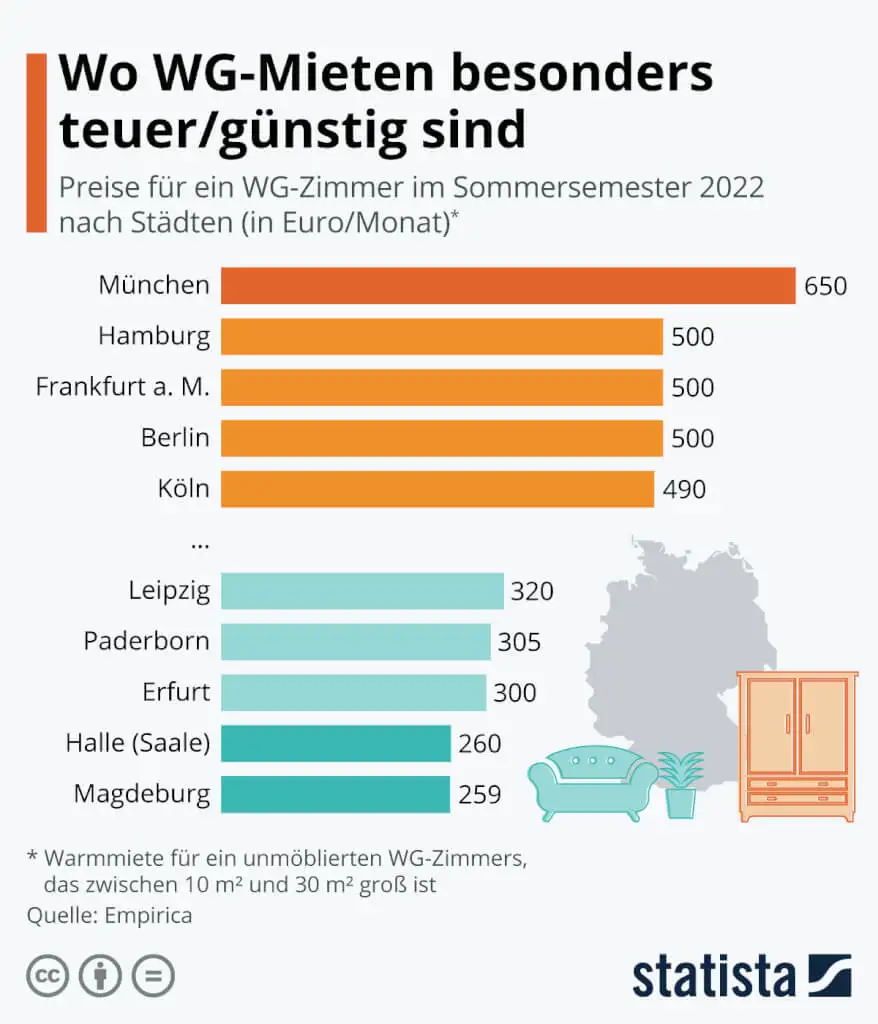
At the Berlin Studierendenwerk (studierendenWERK BERLIN), the average rent in 2024 was €336.56; rents ranged from €210 to €573, depending on the facilities and state of renovation (2024 Annual Report). At the Aristotelessteig hall of residence, according to the hall’s website, a single room in a shared flat costs between €294 and €315, whilst a single apartment costs between €319 and €365 (undated page, accessed in November 2026). It does not state whether service charges are included, so do check with the Studierendenwerk before applying.
By way of comparison: on the private housing market in Berlin, a 30-m² sample flat costs an average of €725, whilst a room in a shared flat costs €659, both warm (Warmmiete, meaning including service charges and heating), according to the MLP Student Housing Report 2026 (as at 30 September 2026).
In Munich, the Studierendenwerk München Oberbayern (the local student services organisation) lists, in its rent price list (as at October 2026), monthly warm rents (Warmmiete, meaning including service charges and heating) for single apartments ranging from approximately €363 to €538, depending on the residential complex. On the open market, according to the MLP Student Housing Report 2026 (as at 30 September 2026), a 30-m² sample flat costs €882 warm, whilst a room in a shared flat costs €849 warm.
You can also apply for housing benefit for a room in a hall of residence, but only if you are not, in principle, entitled to BAföG – for example, if you are studying for a second degree or have exceeded the maximum funding period. Anyone who would, in principle, be eligible for BAföG is excluded, even if the payment is €0 due to income. If you receive BAföG solely as a loan, housing benefit remains an option (§ 20(2) of the Housing Benefit Act (WoGG)).
Types of accommodation
Student halls of residence offer a wide variety of accommodation types, and prices vary accordingly.
For example:
- Typical shared flats as we know them. In some student halls of residence, for example, you can also apply for such shared flats together with friends.
- Single apartments where, for example, you still have to share the kitchen or the bathroom.
You can find out exactly what the different types of accommodation are like on the relevant website of your Studierendenwerk. If necessary, you can also specify a preference when applying.
Advantages of student halls
Many halls of residence are run not only by the Studierendenwerk but also by a student self-government. Among other things, it regulates communal life in the hall. Some flats do not have enough space for a washing machine, which is why there are usually rooms with washing machines that can be used for a fee.

One thing that first-year students particularly appreciate is the communal areas. This is where residents can meet up for various leisure activities. Some halls of residence also have gyms, party rooms or music rooms.
Of course, how intensively such facilities are used depends on the halls of residence and the students living there.
Most student halls of residence are conveniently located not far from a university. The local Studierendenwerk is usually responsible for allocating places. When applying for a flat, you can indicate your preference for a specific hall of residence. However, whether a place will actually become available there and whether you will then be accepted is another matter.
How are places in student halls of residence allocated?
The allocation criteria vary depending on the location. Places in halls of residence may, for example, be allocated by a lottery or on a first-come, first-served basis. Furthermore, applicants’ special needs are taken into account. For instance, student halls of residence also offer special accommodation units for students with children, as well as accessible flats for wheelchair users. Students with physical disabilities or chronic illnesses are given priority when places are allocated.
International exchange and programme students usually secure their place in student halls through their university; direct applications are often not permitted. In Munich, the universities’ International Offices allocate the limited number of rooms available as part of the Servicepaket (service package), which includes not only the hall of residence room but also a welcome pack, tutors and a cultural programme. In Berlin, a separate procedural rule applies to programme students and scholarship holders; furthermore, the Studierendenwerk may enter into separate agreements with universities (§ 4(1) and § 6 of the Guidelines, valid from April 2015). You should therefore first enquire at your university’s International Office. Without such a quota, your only option is the standard application process, which involves a waiting period, and the Studierendenwerk can advise you on private accommodation.
How long will it take before I get a place in student halls?
This depends very much on where you’re studying and how popular the hall of residence is. Halls of residence in the city centre are usually much more popular than those on the outskirts of the city.
Something I didn’t know before – at least that’s how it is here in Berlin – is that shared flats (WGs) are allowed to choose their own flatmates and can therefore advertise a vacant room themselves. So, for example, just have a look at ‘WG gesucht’ or a similar website. That way, if you’d be happy with a room in a shared flat, you’ll at least have the chance to bypass the waiting list at the Studierendenwerk.

When can and should I apply?
As early as possible! However, as a first-year student, you can only apply once you have already enrolled. This means you must have already paid your semester fee. Unfortunately, this means you cannot apply whilst you are still doing your school-leaving exams (Abitur).
How long can I stay in student halls?
The Berlin Studierendenwerk limits the total length of tenancy to ten semesters, i.e. five years. Students in the final stages of their degree, single parents, part-time students, students with a disability or chronic illness, and international students may stay for up to four semesters longer (§ 3 of the guidelines, in force since April 2015). This is sufficient to complete a degree within the standard period of study. Other Studierendenwerke have their own rules.
Is a room in student halls worth it?
In my opinion, absolutely! You make lots of new friends and are never really on your own, unless you want to be. Game nights, film nights or cooking evenings with others are always great fun, and there are always one or two cool parties going on in our student halls of residence. In summer, there isn’t a single sunny day that isn’t spent in the garden having a barbecue and chilling out.
Just as in normal shared flats or accommodation, there are always occasional problems with noise or tidiness, but that’s definitely something I can put up with.
All in all, I wouldn’t want to miss the experience.